
A woman ends the conversation after two minutes.
You go home and conclude:
“I’m unattractive.”
Interesting diagnosis.
No examination. No second opinion. No actual evidence beyond one interaction.
Case closed.
This is one of the biggest problems I see with guys trying to improve their dating lives. They are not just making mistakes in the interaction.
They are making mistakes in the post-game analysis.
Global Judgments Are Useless
Compare these two conclusions:
“I’m bad with women.”
“I asked six questions in a row and gave her almost nothing to respond to.”
One of those makes you feel terrible and gives you nothing to practice.
The other gives you something concrete to change on the next approach.
Same with:
“I’m ugly.”
Versus:
“I approached with weak eye contact, talked too quietly and never made my intent clear.”
The first conclusion may or may not contain some truth about how attractive you are relative to someone else. But it is still far too broad to be useful.
The second gives you behaviors you can test.

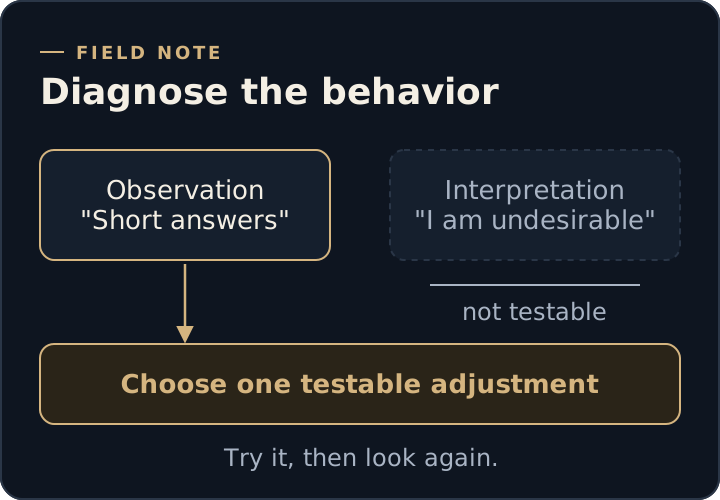
Separate Observation From Interpretation
This is a simple habit that can change the way you review interactions.
Ask yourself:
What did I actually observe?
Then:
What story did I add afterward?
Observation:
“She gave me short answers and kept looking toward her friends.”
Interpretation:
“I am fundamentally undesirable.”
Observation:
“She gave me her number but did not respond the next day.”
Interpretation:
“I always screw everything up.”
Observation:
“I hesitated for twenty minutes and never approached.”
Interpretation:
“I need a better opener.”
See the problem?
A lot of men are solving imaginary causes.
Ask What Happened Before the Result
Results are useful, but they are not explanations.
“She left” is a result.
What happened before she left?
Did the conversation lose energy?
Were you standing too close?
Did you keep talking after she started disengaging?
Did she suddenly get a call and genuinely have somewhere to go?
Was she never interested in the first place?
You need context.
This is why I dislike advice that reduces every interaction to “success” or “failure.” A number can come from a weak interaction. A conversation can end even when you did almost everything well.
Your job is to find what was actually under your control.
One Client Couldn’t See the Problem
I had a client during an in-person bootcamp who was having trouble with his approaches.
The easy conclusion would have been something vague: bad vibe, low confidence, women weren’t receptive.
Then we reviewed what was happening.
He was getting too close.
That was it.
He was unintentionally crowding women and making the interaction less comfortable.
“Give her more space” is useful feedback.
“I have bad energy” is not.
Another client watched footage of himself and said it looked even worse than he had pictured in his head.
Painful?
A little.
Useful?
Extremely.
Because you cannot fix a behavior you do not realize you are doing.
Stop Changing Five Things at Once
Once you identify a real issue, do not respond by rebuilding your entire personality before the next approach.
Pick one adjustment.
Talk more slowly.
Stand at a better distance.
React to her answers instead of immediately asking another question.
Show your intent earlier.
Leave sooner when she clearly is not interested.
Then test it.
If you change ten variables at once, you will have no idea what helped.
This is why I like a simple loop:
Approach.
Review.
Adjust one thing.
Approach again.
That is much closer to training a skill than endlessly judging yourself.
Your Worst Interaction Is Not Your Identity
A rough approach is data.
That is all.
You can be awkward tonight and better next month.
You can miss obvious interest once and learn to recognize it later.
You can be terrible at telling stories now and become good through practice.
The problem is when every mistake becomes proof of a permanent trait.
If approach anxiety is what stops you before you even have anything to review, start with Why You Freeze Before Approaching Women.
And if your conversations tend to become factual Q&A sessions, read Why Your Conversations With Women Feel Like Interviews.
The biggest advantage of having an experienced coach beside you is not motivational yelling. It is diagnosis.
During my 3-Day In-Field Bootcamps, I can watch what you actually do, compare it with what you thought you did and help you identify the specific behavior worth changing next.
Because “I’m bad with women” is not a diagnosis.
It is a sentence.
And usually a lazy one.
Stop Reading.
Start Doing.
Real approaches, hidden-mic feedback in real time, and a complete rewiring of how you show up. Three days in Las Vegas with AG.