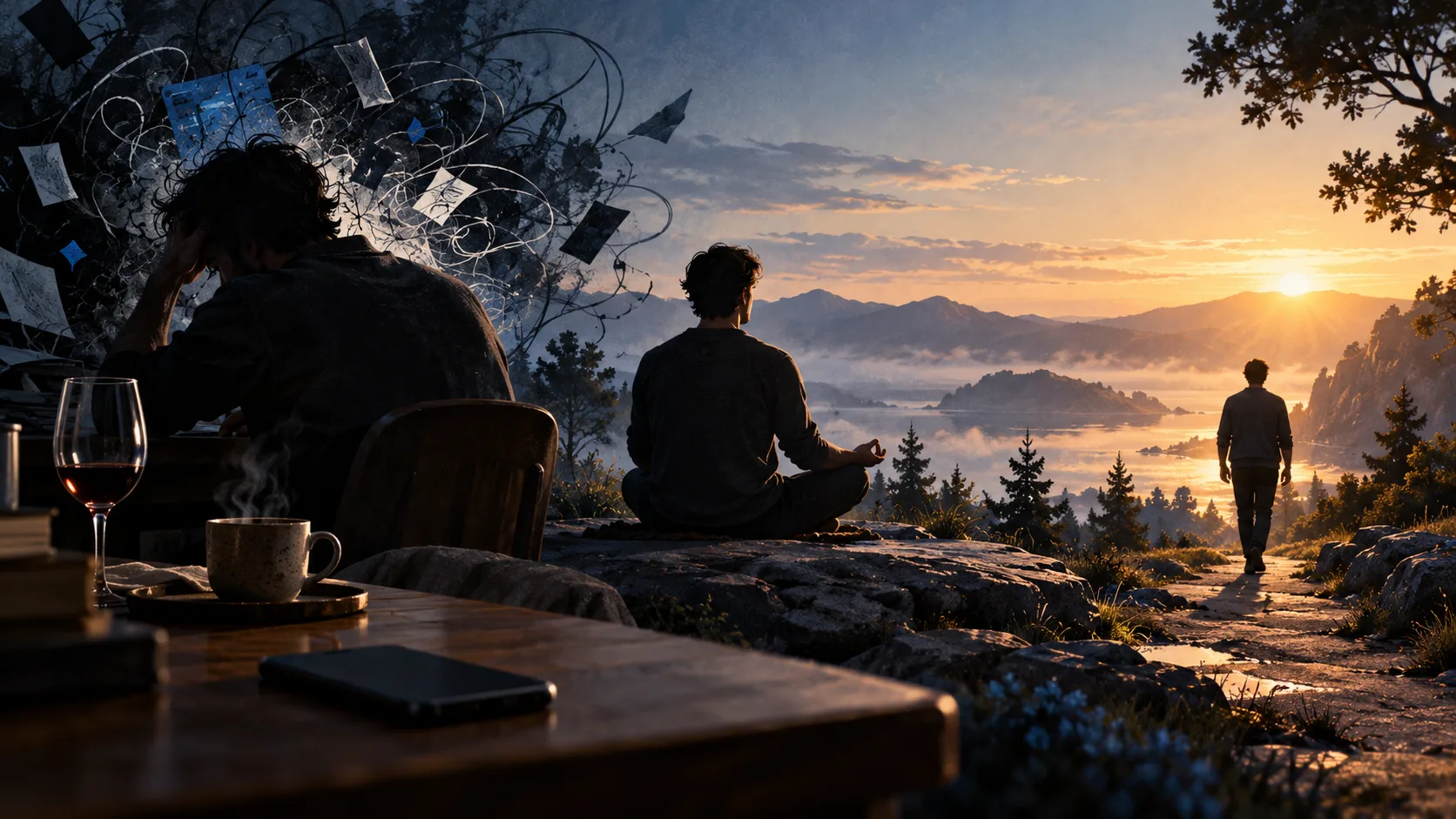
I've tried a lot of things for anxiety.
Breathing exercises.
Books.
Supplements.
Different routines.
Reading approximately 47 explanations of the nervous system while actively making myself more nervous.
Some of those things help.
But if I had to identify the changes that have had the biggest effect on my day-to-day anxiety and stress, they're surprisingly simple.
- I dramatically limit how much content I consume.
- I meditate.
- I walk a lot, preferably outside in the sun.
- I minimize alcohol and caffeine.
When I'm actually consistent with all four, I'd estimate that my normal anxiety and stress levels drop by around 80 percent.
That's obviously not a laboratory measurement.
I'm not claiming that everyone who meditates, deletes TikTok and takes a walk will experience an 80 percent reduction in anxiety.
That's simply my subjective experience.
What's interesting is that when you look at the research, all four habits have legitimate scientific support.
And I don't think they work independently.
They reinforce each other.
1. I Almost Completely Block Content During the Day
This may be the biggest environmental change I've made.
I use Opal on my phone and Cold Turkey on my laptop to block most of the websites and apps that allow me to mindlessly consume content.
YouTube.
Social media.
News.
Random websites.
Anything that can turn:
“I'll check this for five minutes.”
into:
“Apparently I've spent 96 minutes learning about a controversy involving three people I didn't know existed this morning.”
I can circumvent the blocks when I genuinely need something for work.
But the default is that they're blocked.
Then from 8 PM to 9 PM, I have a one-hour window where I can consume whatever I want.
I'm not trying to join a monastery.
I'm trying to stop giving the internet unlimited access to my attention for 16 hours per day.
And there is now surprisingly good experimental evidence that doing something like this can improve mental health.
What Happens When Researchers Actually Reduce Screen Time?
A lot of research on phones and social media is correlational.
People who use social media more often sometimes report more anxiety.
Okay.
But maybe anxious people simply use social media more.
Correlation does not tell us which direction the arrow points.
Randomized experiments are much more interesting.
In one randomized controlled trial, researchers had university students reduce smartphone screen time to two hours or less per day for three weeks.
Compared with the control group, the screen-time reduction group improved on stress, depressive symptoms, well-being and sleep quality.
The effects weren't miraculous.
But they were real.
Another experiment involving more than 600 people compared completely avoiding smartphones for a week with simply reducing daily smartphone use by one hour.
Both groups experienced improvements, including reductions in anxiety and depressive symptoms.
Interestingly, the more sustainable strategy wasn't total abstinence.
It was simply using the phone less.
That matches my experience almost perfectly.
I don't think technology is evil.
My entire career would become fairly inconvenient if I decided electricity was ruining society.
The problem is unlimited consumption.
The Mobile Internet Experiment Is Even More Interesting
A randomized trial took a more aggressive approach.
Instead of asking people to stop using their phones, researchers blocked mobile internet access on participants' smartphones for two weeks.
Texts and phone calls still worked.
Desktop internet still worked.
Their phones basically became phones again.
The intervention improved mental health, subjective well-being and objectively measured sustained attention.
Compliance was limited, and follow-up was short. This was a two-week mobile-internet experiment, not proof that my specific 8 PM to 9 PM schedule is the answer for everyone.
Participants also ended up consuming less media and spending more time doing things like exercising, socializing face-to-face, spending time in nature and sleeping.
That points toward something I think gets overlooked.
Maybe the benefit isn't simply:
Phone bad.
Maybe it's:
When I'm not staring at a screen, I naturally start doing things that make me feel better.
I go for a walk.
I work.
I talk to someone.
I sit somewhere without needing stimulation for 11 consecutive seconds.
A revolutionary concept.
The Bigger Problem for Me Is Constant Stimulation
I notice this with content in general.
YouTube can do it.
Podcasts can do it.
Reddit can do it.
News can do it.
Even supposedly productive educational content can do it.
There is a point where “learning” turns into constantly feeding the brain new inputs because being unstimulated feels uncomfortable.
And when I spend hours doing that, my mind feels louder.
More fragmented.
More reactive.
When I block it, something strange happens.
Initially I feel bored.
Then eventually my brain seems to remember that boredom is not a medical emergency.
Which leads directly into the second thing.
2. I Meditate
Meditation is one of the other major things that lowers my baseline anxiety.
And I think it works particularly well in combination with consuming less content.
Blocking content reduces how much mental noise I'm constantly feeding myself.
Meditation changes my relationship with the noise that's already there.
Those are two different problems.
You can remove Instagram from your phone and still have your own brain running a 24-hour cable news network.
Meditation helps with that part.
Meditation Is Not About Having No Thoughts
I think this is one of the biggest misconceptions about meditation.
People sit down.
They focus on their breath for eleven seconds.
Then their brain says:
Remember that mildly embarrassing thing you said in 2017?
They get distracted.
Then they think:
I'm terrible at meditation.
No.
That was the meditation.
The point isn't to somehow force your mind into silence.
The practice is noticing:
I'm thinking.
And then returning your attention.
Over and over again.
That's the rep.
It's almost like going to the gym and getting angry because the weight keeps falling toward the floor.
That's literally the thing you're training against.
The Scientific Evidence for Mindfulness Is Actually Pretty Good
Meditation has unfortunately acquired a layer of marketing that makes it sound like ten minutes of breathing will turn you into a levitating Buddhist billionaire.
You don't need any of that.
The actual evidence is interesting enough.
A meta-analysis of 29 studies involving 2,668 healthy adults found that Mindfulness-Based Stress Reduction was associated with moderate improvements across psychological outcomes, with particularly meaningful effects on stress and moderate effects on anxiety and depression. The improvements also persisted at follow-up, although the researchers noted substantial variation between studies.
That last part matters.
Meditation isn't equally effective for everyone.
Different studies use different programs.
And an eight-week structured mindfulness course is not the same thing as downloading an app and meditating twice while waiting for an Uber.
Still, taken together, the evidence suggests something real is happening.
Meditation Has Also Been Tested in People With Anxiety Disorders
Researchers have tested mindfulness programs specifically in people with clinical anxiety.
In one randomized controlled trial, 76 people with anxiety disorders were assigned either to an eight-week Mindfulness-Based Stress Reduction program or a waiting-list condition.
People completing the mindfulness program showed substantial reductions in anxiety symptoms, and improvements were still present six months later.
The authors were appropriately cautious because there wasn't an active treatment comparison, meaning some of the benefit could potentially have come from nonspecific factors such as attention, expectation or participating in a structured program.
That's why another trial is particularly useful.
Researchers took people with generalized anxiety disorder and compared an eight-week mindfulness program against an active stress-management education program.
Both groups improved on the study's primary anxiety measure.
That primary measure was the Hamilton Anxiety Rating Scale. There was no significant difference between the two groups on that outcome.
But the mindfulness group showed larger improvements on several secondary measures and appeared more resilient during a laboratory stress challenge.
So we're not talking about:
“Scientists proved meditation eliminates anxiety.”
They didn't.
We're talking about:
Meditation appears to be a legitimate tool for reducing anxiety and stress, with a growing randomized evidence base behind it.
That's plenty interesting to me.
Why Might Meditation Work?
One of the most useful concepts here is something psychologists call decentering.
That's basically the ability to experience a thought as a thought rather than immediately treating it as reality.
For example:
Your brain produces:
Something feels wrong.
Without much awareness, that can turn into:
Something feels wrong.
Therefore something probably is wrong.
Why do I feel this way?
Was that pain normal?
Am I going to feel anxious all day?
What if it gets worse?
Now you're not only experiencing anxiety.
You're performing an investigation into the anxiety.
With graphs.
Witness testimony.
Possibly a congressional hearing.
Meditation can train a different response:
Interesting. I'm having the thought that something is wrong.
That's a surprisingly important distinction.
Research on people with generalized anxiety disorder has found that increases in decentering during mindfulness treatment are associated with reductions in anxiety.
That analysis involved only 38 people. Decentering is a plausible mechanism, not a proven universal explanation for why meditation helps.
You aren't necessarily removing the original thought.
You're removing some of the chain reaction after it.
And for me, that's huge.
Meditation Changes the Goal
I used to think the purpose of dealing with anxiety was:
Make the anxiety go away.
That's understandable.
Unfortunately, it can create another problem.
Now every time anxiety appears, you're checking:
Is it gone yet?
How about now?
Still anxious?
Why isn't this working?
Congratulations.
You've turned relaxation into another performance metric.
Meditation teaches almost the opposite response.
Notice what's happening.
Allow it to be there.
Don't immediately react.
Return your attention to what's actually happening.
Paradoxically, not desperately trying to eliminate anxiety can reduce the amount of secondary anxiety you create around it.
This is one reason mindfulness-based approaches are interesting.
The objective isn't always to change the content of every thought.
Sometimes it's to stop treating every thought as an instruction.
Meditation Is Attention Training
There's another reason I think meditation fits so well with reducing digital stimulation.
Modern content constantly trains your attention to move.
New video.
New notification.
New tab.
New post.
New controversy.
New dopamine-flavored object approximately every four seconds.
Meditation asks you to do the opposite.
Pick something.
Usually your breathing.
Stay with it.
Notice when attention wanders.
Bring it back.
Then do that hundreds of times.
In that sense, meditation isn't just “relaxation.”
It's deliberate attention training.
And considering how much of my anxiety is fueled by attention bouncing between physical sensations, future problems, intrusive thoughts and random internet stimuli, that's useful.
Meditation Doesn't Need to Feel Peaceful to Work
Some of my meditation sessions feel calming.
Others feel like I scheduled a private meeting with every thought I was hoping not to have.
That's okay.
I try not to judge the session based entirely on how relaxed I feel during it.
The skill I'm practicing is noticing what my mind is doing without immediately following it.
Sometimes calm is the result.
Sometimes the result is simply getting slightly better at not being dragged around by my own brain.
I'll take either one.
3. I Walk a Lot, Preferably Outside in the Sun
Walking may be the most underrated mental-health intervention on Earth because nobody can sell it to you for $297.
You already have the equipment.
For me, the ideal version is:
Walk outside. Get sunlight. Do it especially early in my day.
Several potentially useful things are happening at once.
You're exercising.
You're getting out of your house.
You're probably getting away from screens.
You're exposing yourself to outdoor light.
You're changing your environment.
And depending on where you walk, you're spending time around nature or other people.
It's difficult to separate those variables perfectly.
Fortunately, walking itself has strong evidence.

Walking Reduces Anxiety
A 2024 systematic review and meta-analysis analyzed 75 randomized controlled trials involving 8,636 participants.
Across the trials measuring anxiety, walking significantly reduced anxiety symptoms compared with inactive controls.
There was substantial variation between studies. Walking also did not significantly outperform active comparison treatments.
Benefits appeared across different walking frequencies, durations and settings.
Indoor walking helped.
Outdoor walking helped.
Walking alone helped.
Walking with other people helped.
Again, this is not:
Walk around the block once and cure your anxiety disorder.
But “go for a walk” is considerably less stupid advice than it sounds.
Why I Specifically Like Walking in Sunlight
Light is one of the primary signals your brain uses to determine what time of day it is.
Your body has a roughly 24-hour internal clock, your circadian rhythm, which influences sleep, wakefulness, hormones, body temperature and a ridiculous number of other biological processes.
Light hitting the eyes provides timing information to that system.
Timing matters.
Morning light generally shifts the circadian clock earlier, while substantial light exposure later at night can push it later.
That doesn't mean morning sunlight directly cures anxiety.
The timing is relative to your biological night, not just the number on your clock.
The stronger claim is that outdoor light, particularly earlier in the biological day, provides a powerful signal to the circadian system.
And circadian regulation matters enormously for sleep.
Which matters enormously for how I feel mentally.
So if my morning walk simultaneously gives me:
exercise,
less screen time,
outdoor light,
and a more stable sleep-wake signal,
that's a pretty impressive return on investment.
I Don't Make the Walk Complicated
I don't need:
perfect Zone 2 heart rate,
a weighted vest,
a specialized breathing protocol,
a podcast about optimization,
Scandinavian hiking poles,
and seven different supplements.
I need shoes.
Then I walk.
The goal is not to turn walking into another thing I can obsess over.
The goal is to become less anxious.
4. I Minimize Caffeine and Alcohol
This one is painfully obvious in my own life.
The two drugs people commonly use to:
wake themselves up
and:
calm themselves down
can both make anxiety considerably worse under the wrong conditions.
Let's start with caffeine.

Caffeine Can Literally Create Anxiety Symptoms
Caffeine is a stimulant.
That's why it works.
It primarily blocks adenosine receptors, reducing the normal buildup of sleep pressure and increasing alertness.
Fantastic if you're tired.
Potentially less fantastic if your nervous system already thinks you're being chased by a tiger.
A meta-analysis examining caffeine and anxiety found that caffeine significantly increased anxiety, with larger effects at higher doses.
This was a small, heterogeneous evidence base: 546 participants across the included caffeine-anxiety studies. Useful evidence, not a magic safe-dose calculator.
Higher doses, particularly those around or above several hundred milligrams, were associated with considerably larger increases.
But I wouldn't interpret any specific dose as a magical threshold.
People vary enormously in caffeine sensitivity.
Genetics matter.
Tolerance matters.
Sleep matters.
Existing anxiety matters.
And how quickly you consume it matters.
For me, the practical conclusion is much simpler.
If I'm already anxious, adding a stimulant is probably not helping.
Caffeine Can Produce the Exact Sensations Anxious People Fear
Think about what enough caffeine can produce.
Faster heartbeat.
Restlessness.
Sweating.
Shakiness.
Alertness.
Difficulty sleeping.
Now imagine someone prone to anxiety experiencing those sensations.
The body says:
We're stimulated.
The anxious brain says:
Excellent. I have reviewed the evidence and concluded we're dying.
Then anxiety creates more physical symptoms.
Which creates more anxiety.
Wonderful system.
Reducing caffeine doesn't eliminate anxiety for me.
But it removes one obvious source of physiological stimulation that can pour gasoline on it.
Alcohol Is More Deceptive
Alcohol is trickier because initially it often does reduce anxiety.
That's why people use it for anxiety.
Have a few drinks and:
Your inhibition drops.
Muscle tension may decrease.
Social anxiety feels easier.
You stop overthinking.
For several hours you may genuinely feel calmer.
Which makes alcohol extremely convincing.
The problem is what happens afterward.
Alcohol Can Make Sleep Worse Even When It Makes Falling Asleep Easier
One of the most common misconceptions about alcohol is that it helps sleep.
It can make you sleepy.
That's not the same thing as improving sleep.
Experimental research shows that alcohol changes normal sleep architecture, including disrupting REM sleep, with the disruption generally becoming more pronounced at higher doses.
The review combined 27 experimental studies. REM disruption was also seen at lower doses, not just after a heavy night.
So you can experience the bizarre situation where:
Alcohol makes you sleepy.
You conclude:
Alcohol helps me sleep.
Then you wake up feeling like your nervous system spent eight hours being interrogated by the CIA.
Not ideal.
Alcohol and Anxiety Can Become a Feedback Loop
The relationship isn't simply:
Alcohol causes anxiety.
It's more complicated.
Anxiety can make people more likely to drink.
Drinking can temporarily decrease anxiety.
That reinforces drinking as a coping mechanism.
Then sleep disruption, hangovers, physiological rebound effects and heavier patterns of use can make the following period worse.
Which can create another urge to drink.
That's the loop I'm much more interested in avoiding.
For someone who isn't particularly anxious and drinks lightly, alcohol may not create some dramatic anxiety problem.
For someone who already struggles with anxiety, drinks heavily, sleeps badly afterward and then uses alcohol again because they're anxious?
Very different situation.
Important: If someone drinks heavily or frequently enough to be physically dependent, suddenly stopping can be dangerous. Alcohol withdrawal can require medical treatment. That's different from simply deciding to drink less.
These Four Habits Aren't Independent
This is probably the most important part of the entire system.
I don't think:
content,
meditation,
walking,
caffeine,
and alcohol
operate separately.
They interact.
Imagine two versions of the same day.
Day One
Wake up.
Immediately check phone.
Scroll.
Coffee.
More scrolling.
Work for 25 minutes.
YouTube.
More caffeine because productivity is apparently now a pharmacological problem.
Sit inside most of the day.
Get stressed.
Never really stop and observe what's happening mentally.
Drink at night to relax.
Sleep worse.
Wake up anxious.
Use phone to distract yourself from the anxiety.
Drink coffee because you slept badly.
Repeat.
Every behavior makes the next behavior more likely.
Now compare that with:
Day Two
Wake up.
Phone content is blocked.
Meditate.
Go outside.
Walk.
Get daylight.
Come home.
Work because there isn't much else available to procrastinate with.
Use less caffeine.
Don't drink.
Have my one-hour content window later.
Sleep better.
Wake up feeling better.
Repeat.
This is why I've become much more interested in systems than individual anxiety hacks.
Maybe I could learn another breathing technique.
Or maybe I could stop repeatedly constructing the exact psychological and physiological conditions that make me anxious.
The second strategy has worked much better.
My Actual Anxiety-Reduction System
If I had to reduce everything into something practical, this is roughly what I do.
During the day
Opal blocks distracting content on my phone.
Cold Turkey blocks it on my computer.
If I legitimately need something for work, I can override the block.
But I have to make that decision consciously rather than opening YouTube because my finger apparently has its own political agenda.
I meditate
The point isn't to force myself into a trance.
I notice thoughts.
I notice sensations.
I notice when my attention gets pulled away.
Then I return.
Some days that feels extremely calm.
Other days my brain behaves like somebody shook a filing cabinet down a staircase.
I still did the practice.
I walk
Preferably outside.
Preferably with sunlight.
Preferably earlier in my day.
I don't obsess about designing the scientifically perfect walk and then somehow end up staying inside.
I keep caffeine low
Especially if I'm already anxious.
And I pay attention to the total amount rather than pretending four separate caffeinated drinks somehow don't know about each other.
I minimize alcohol
Because however relaxed it makes me for a few hours, I care much more about how I feel the following day.
The one window
8 PM to 9 PM
I allow myself a content window.
I can watch videos.
Check things.
Consume whatever I want.
Then the blocks return.
That turns entertainment into something deliberate rather than the background state of my entire life.
The Goal Isn't to Never Feel Anxious
This might be the most important lesson meditation has reinforced for me.
I don't think the goal should be constructing a life where I never experience anxiety.
That's impossible.
And ironically, becoming obsessed with eliminating every trace of anxiety can turn anxiety itself into something terrifying.
My goal is different.
I want my baseline nervous system to stop being unnecessarily provoked all day.
And when anxiety does appear, I want to be better at experiencing it without immediately turning it into a crisis.
I don't need:
constant stimulation,
constant information,
constant caffeine,
alcohol-induced sleep disruption,
zero awareness of what my own mind is doing,
and then another book explaining why I feel stressed.
Sometimes the complicated psychological problem has a surprisingly boring environmental component.
When I consume less content, meditate, walk outside regularly, get daylight and minimize alcohol and caffeine, I'm calmer.
A lot calmer.
My estimate is roughly 80 percent calmer when I'm doing all of these consistently.
Maybe your number would be 20 percent.
Maybe it would be 50.
Maybe these aren't your biggest variables at all.
But they're cheap enough to test.
For one week:
Block recreational content during the day.
Give yourself one deliberate window to consume it.
Meditate every day.
Walk outside.
Get outdoor light earlier in your waking day when possible.
Reduce caffeine.
Avoid or dramatically reduce alcohol if it's safe for you to do so.
Then pay attention to how you actually feel.
Not how you think you should feel.
Not what somebody on YouTube tells you your cortisol is doing.
How you feel.
Because you might discover that your anxiety doesn't need another 63-tab research project.
It might need fewer tabs open.
Studies Referenced
- 01Content consumption · Screen-time reductionSmartphone screen time reduction improves mental health: a randomized controlled trial
- 02Brailovskaia et al. · Smartphone reduction and abstinenceFinding the “sweet spot” of smartphone use: Reduction or abstinence to increase well-being and healthy lifestyle?! An experimental intervention study.
- 03Content consumption · Mobile internet experimentBlocking mobile internet on smartphones improves sustained attention, mental health, and subjective well-being
- 04Khoury et al. · Mindfulness meta-analysisMindfulness-based stress reduction for healthy individuals: A meta-analysis
- 05Vøllestad et al. · Anxiety-disorder randomized trialMindfulness-based stress reduction for patients with anxiety disorders: Evaluation in a randomized controlled trial
- 06Hoge et al. · Active-control randomized trialRandomized controlled trial of mindfulness meditation for generalized anxiety disorder: effects on anxiety and stress reactivity
- 07Meditation · Decentering mediation analysisChange in Decentering Mediates Improvement in Anxiety in Mindfulness-Based Stress Reduction for Generalized Anxiety Disorder
- 08Walking · Systematic review and meta-analysisThe Effect of Walking on Depressive and Anxiety Symptoms: Systematic Review and Meta-Analysis
- 09NIGMS · Circadian rhythmsCircadian Rhythms
- 10Outdoor light · Morning phase-shifting researchPreflight adjustment to eastward travel: 3 days of advancing sleep with and without morning bright light
- 11Caffeine · Anxiety meta-analysisCaffeine intake and anxiety: a meta-analysis
- 12Alcohol · Sleep systematic review and meta-analysisThe effect of alcohol on subsequent sleep in healthy adults: A systematic review and meta-analysis
- 13NIAAA · Alcohol and co-occurring mental health conditionsMental Health Issues: Alcohol Use Disorder and Common Co-occurring Conditions
- 14NIAAA · Withdrawal and reducing alcohol safelyShould You Cut Down or Quit?
Stop Reading.
Start Doing.
Real approaches, hidden-mic feedback in real time, and a complete rewiring of how you show up. Three days in Las Vegas with AG.