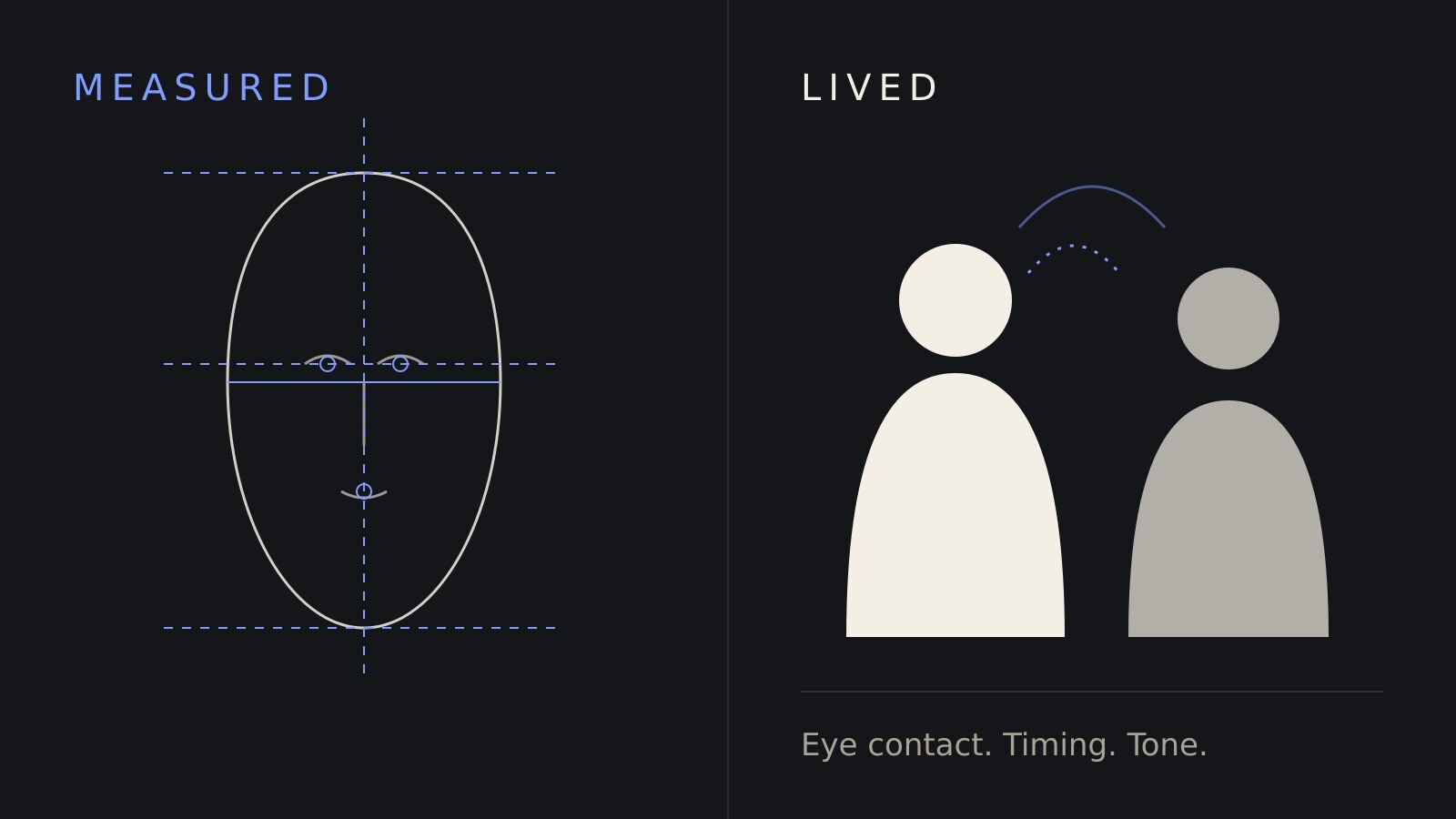
Spend enough time in online looksmaxxing communities and you start getting the impression that your romantic future was decided by your maxilla, orbital vector, gonial angle, canthal tilt and PSL score.
Bad canthal tilt? It’s over.
Under 6 feet tall with anything less than hunter eyes? You may as well begin preparing for the monastery.
Apparently a woman has never enjoyed a conversation. She has simply been calculating your facial ratios in the background.
There is one very inconvenient problem with making fun of all this.
Looks actually do matter. Pretending otherwise is stupid.
Improving your appearance is useful. Attractiveness affects how people respond to you. Nobody needs to pretend that a good haircut and a fitter body are irrelevant because some guy on a forum has become emotionally dependent on measuring his jaw.
But “attractiveness affects dating outcomes” and “facial structure largely determines your romantic ceiling” are not the same claim.
The first has substantial evidence behind it. The second takes that evidence, adds a spreadsheet, and starts making promises the research never made.
First, the uncomfortable part: looks matter
The Langlois et al. 2000 review pulled together 11 meta-analyses. Attractive people were generally judged and treated more positively. People also showed substantial agreement about who was attractive, including across cultures.
So no, beauty is not entirely subjective. And yes, being attractive can make life easier. We can admit that without joining a skull-measuring support group.
Eastwick, Luchies, Finkel and Hunt’s 2014 meta-analysis covered 97 samples across attraction and relationship research. Physical attractiveness predicted romantic evaluations at around r = .40, similarly for men and women. The sex differences in those correlations were small and not statistically significant.
That is a meaningful association. It is not “40 percent of your dating life is decided by your face.” A correlation across samples is not a personal probability, an immutable limit, or a diagnosis delivered by someone whose profile picture is an anime character.
The practical advice is not complicated. Lose excess fat if that applies to you. Lift. Get a haircut that suits your face. Wear clothes that fit. Take sensible care of your skin. Get better photos instead of using the selfie you took underneath a bathroom spotlight.
Those things can improve how you present yourself. Do them.
If you want to see how appearance and behavior show up together, watch the interaction breakdowns on my YouTube channel. The useful question is not just “How does this guy look?” It is “What happens when he actually opens his mouth?”
Keep the useful part
Looks matter does not mean looks are destiny
Luo and Zhang’s 2009 speed-dating study looked at attraction between people who actually met. Their analysis separated actor, partner and unique relationship components.
In normal English: some people tend to feel more attraction generally. Some people tend to attract more interest generally. And some pairings have something specific going on between those two people.
Looks were not irrelevant in this study. Physical attractiveness was the strongest measured partner predictor for both sexes. That deserves to be said clearly, not quietly edited out because it makes a nicer motivational speech.
But the actor and unique relationship components also mattered. Attraction was not simply a universal ranking of faces that everyone obediently followed.
Picture Guy A. Internet strangers have awarded him a 7.2 PSL score. He has the approved jaw. He also seems tense, speaks like he is defending a dissertation, and gives you the impression that he is waiting for a verdict.
Then picture Guy B. He is less conventionally handsome, but relaxed and playful. He makes strong eye contact without staring somebody down. He knows how to flirt, notices whether she is enjoying it, and does not turn every pause into a personal catastrophe.
This is an illustration, not a laboratory result proving Guy B always wins. Sometimes the more attractive guy has the better interaction too. Congratulations to him. Still, a photo rating does not contain everything that happens when two people meet.
The blackpill model is extremely good at analyzing Guy A’s skull. Dating unfortunately involves meeting humans.
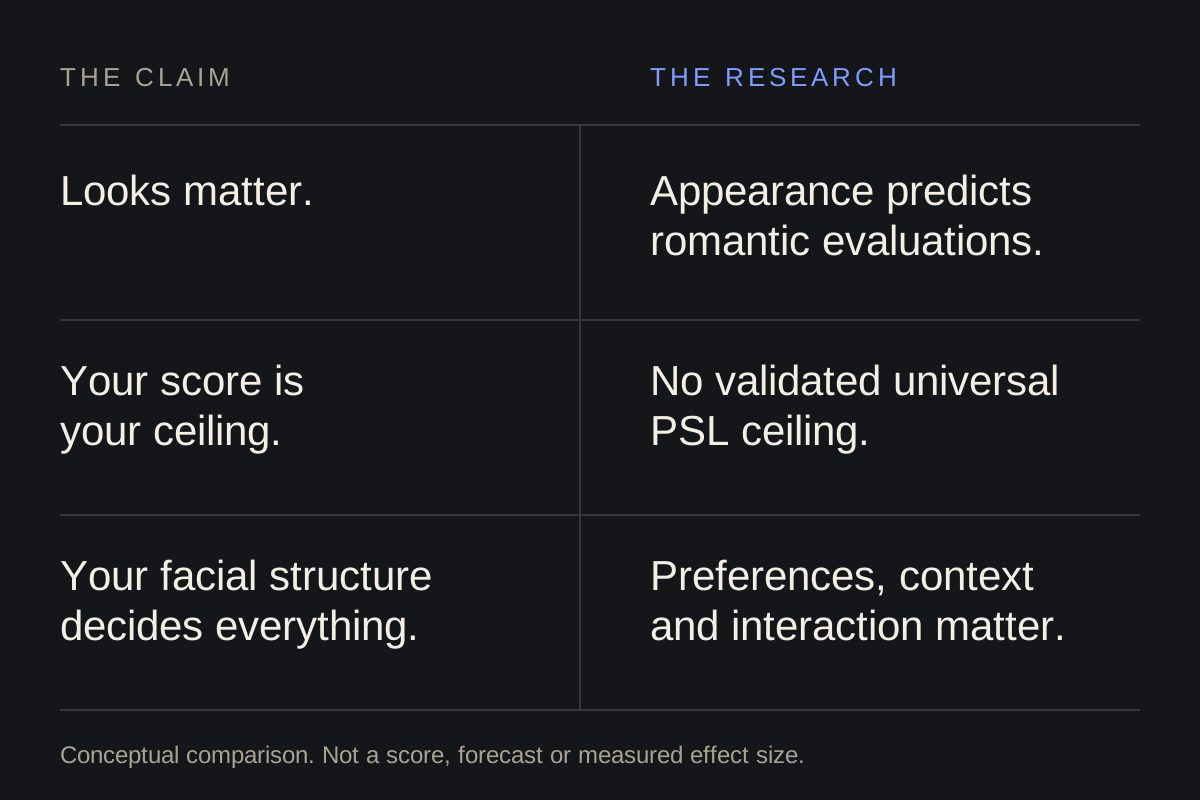
Your PSL score has another problem: women aren’t one woman
Even if you could perfectly predict the average rating of your face, you would still have a fairly obvious problem.
You are not dating the average.
Marcinkowska et al. 2019 studied facial masculinity preferences in 4,483 heterosexual women across 34 countries. Those preferences varied with national social, economic and health conditions. That is not what a single universal optimization target looks like.
The individual-differences work on facial masculinity makes the point another way. Researchers varied faces from extremely feminine to hypermasculine. Different individual characteristics were associated with different preferred levels or different tolerance for low versus high masculinity.
Translation: “more masculine” is not automatically “more attractive to every woman.” A preference can have a range. People can disagree without one of them being wrong about the correct jaw.
Even symmetry research requires a little care. Increasing facial shape symmetry raised attractiveness ratings when skin texture was held constant. Earlier image manipulations could introduce unnatural shapes or texture changes that confused the result.
That supports symmetry as one influence on ratings. It does not validate every facial ratio a forum has promoted into a law of nature.
Average preferences exist. Individual preferences exist too. You do not get to erase the second sentence because the first fits your theory.
Now here’s the study looksmaxxing forums should hate
Eastwick and Finkel’s 2008 study asked people what they wanted in an ideal partner, then used speed dating and follow-up to examine whom they actually desired.
Before meeting, participants gave the familiar answers. Men placed more stated importance on physical attractiveness. Women placed more stated importance on earning prospects.
Then actual people entered the room and made the questionnaire considerably less impressive.
The stated ideal preferences failed to predict what inspired participants’ actual desire at the speed-dating event. The expected sex differences also did not appear in the associations between real-life romantic interest and partners’ attractiveness or earning prospects.
People aren’t especially good at reverse-engineering their own attraction.
Notice what this does not mean. It does not mean appearance stopped mattering. It means the shopping list people can describe is not necessarily a reliable forecast of who will interest them after meeting.
The replication atlas entry records one successful replication of this study. That is useful context, not permission to pretend one paper settles all questions about mate preferences. The broader 2014 review also discusses circumstances in which ideals do have predictive value.
This is why I prefer analyzing actual interactions on A.G. Hayden’s YouTube channel. Watch the eye contact, timing, playfulness, delivery and response. A real exchange gives you information a frozen image and an ideal-partner checklist cannot.
"People aren’t especially good at reverse-engineering their own attraction."
Even who walks across the room changes attraction
Finkel and Eastwick’s 2009 experiment changed something wonderfully unglamorous: who moved from one partner to the next during speed dating.
In some events, men rotated and women stayed seated. In others, women rotated and men stayed seated. Across 350 speed daters, the people who approached were less selective than the people who stayed seated.
When women rotated, they became less selective, and the usual pattern of men being less selective than women disappeared. Increased self-confidence among the rotators helped explain the effect.
Nobody grew three inches between rounds. Nobody had an emergency jaw transplant behind the registration desk. The social situation changed.
This does not guarantee that approaching a particular woman will make her want you. It does show that attraction and selectivity are responsive to something beyond the faces in the room.
If your entire theory of dating lives inside a photograph, you are leaving out the part where people move, act, respond and feel something.
You are studying the scoreboard while refusing to play the game.
Your attractiveness rating is not your dating record
Here’s where the neat little ranking system runs into actual behavior.
In a 2013 study, Hill and colleagues studied 63 fraternity men and had 72 women from affiliated sororities rate their attractiveness. The men also rated one another’s physical dominance. Women’s attractiveness ratings did not significantly predict the men’s reported number of sexual partners in the previous year. Physical dominance did.
A larger 2018 study by Kordsmeyer and colleagues, involving 164 men and an 18-month follow-up, also found that perceived physical dominance, rather than rated sexual attractiveness, predicted their mating-success measures. Here, dominance meant perceived ability to win a physical fight. It wasn’t a test of whether acting threatening toward women gets you dates.
These are limited samples and self-reported outcomes. A nonsignificant result does not establish zero correlation everywhere. But it does complicate the idea that your dating history can be read off an attractiveness score.
Height gives us another useful reality check.
Frederick and Jenkins examined sexual history in a 2015 survey of 60,058 heterosexual adults. The association between men’s height and lifetime partner count was small. Men in the very-short group, 5′2″ to 5′4″, reported a median of five partners. Every taller group, from 5′5″–5′7″ through 6′5″ and above, had a median of seven.
That is two fewer at the median, not two fewer for every short man. The means increased from 9.4 in the shortest group to 12.3 in the tallest. Height mattered, but the differences across most of the height range were modest.
Apparently the research forgot to install the six-foot minimum.
None of this proves looks are irrelevant or tells you how good someone’s relationships were. It shows why a preference, a rating and a lifetime of behavior are different things. Improve your appearance. Then go meet people.
The real danger of looksmaxxing isn’t looksmaxxing
Softmaxxing, if we are using the forum vocabulary, is mostly useful. Improve the things you can improve without turning your face into a full-time research project.
The danger is when appearance optimization becomes avoidance disguised as self-improvement.
“I’ll approach when I lose another 10 pounds.”
“I need to fix my hair first.”
“I need to determine whether my eye area is UEE or LTN.”
Some of those goals might be reasonable on their own. The problem is the condition you attach to them: until everything is sorted, you never have to risk a real interaction.
The goalpost moves. You get fitter, then your photos become the issue. You fix the photos, then discover a new facial measurement. There is always another variable available to a man who desperately wants not to say hello.
You’re not avoiding women anymore. You’re optimizing facial harmony. Much more respectable. Same result.
You are still at home.
If improving your appearance helps you participate more, good. If it gives you a sophisticated reason never to participate, it has become a problem regardless of how useful the haircut was.
"You do not need to complete character creation before you’re allowed to play."
Two tracks. Not two stages.
Bottom line
Looks matter. The research does not require us to deny that, and neither should your dating strategy.
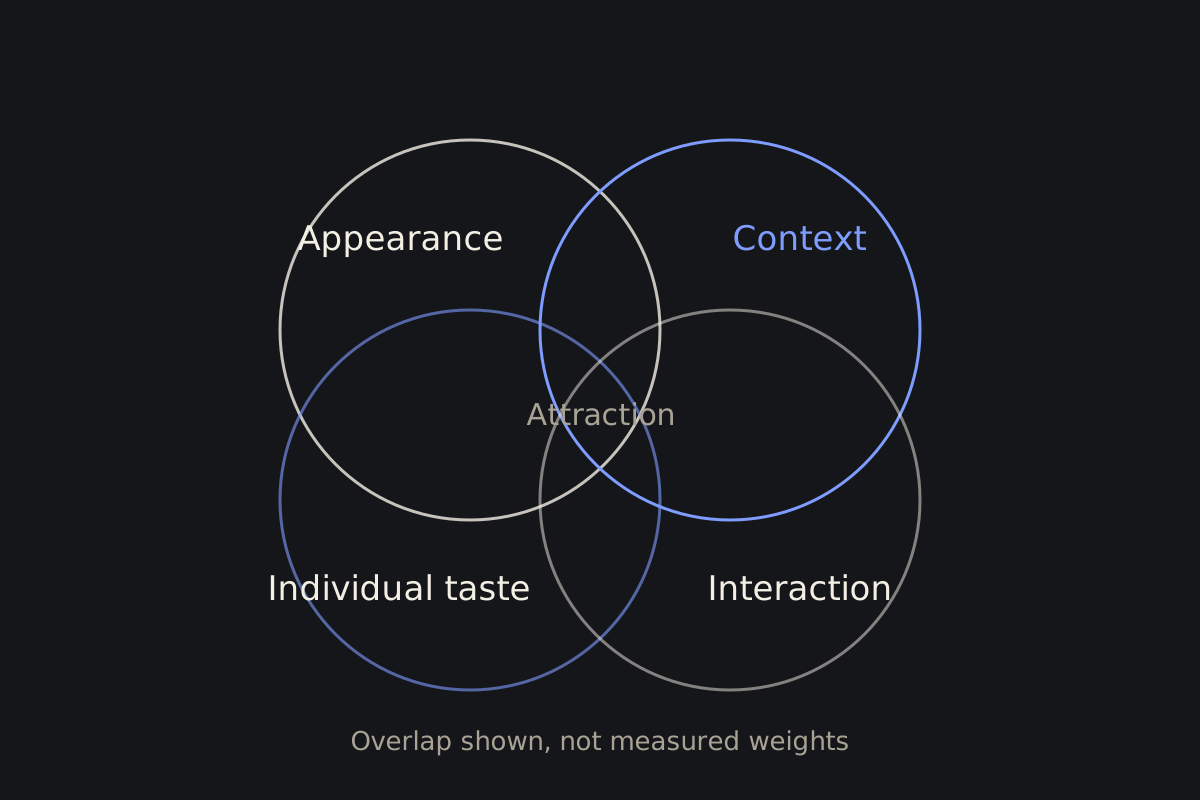
But real-world attraction is messier than a facial-ranking algorithm. Context, individual preferences, who approaches whom, confidence and the unique interaction between two people all belong in the picture.
The studies here do not validate a universal PSL cutoff, a fixed romantic ceiling, or a guarantee that social skill beats attractiveness. They give us reasons to reject a much simpler story: that measuring your face is enough to tell you how your dating life will go.
Improve what you can improve. Then give people a chance to experience you as something other than a photograph.
Do not spend three hours measuring your midface while a less genetically gifted guy is at the bar talking to the woman you were too scared to approach.
If you want to study something useful, watch real interactions on A.G. Hayden’s YouTube channel, then go have some of your own.
Use the information.
Studies Referenced
- 01Langlois et al. · 2000Maxims or myths of beauty? A meta-analytic and theoretical review
- 02Eastwick, Luchies, Finkel & Hunt · 2014The predictive validity of ideal partner preferences: A review and meta-analysis
- 03Eastwick & Finkel · 2008Sex differences in mate preferences revisited: Do people know what they initially desire in a romantic partner?
- 04Luo & Zhang · 2009What leads to romantic attraction: Similarity, reciprocity, security, or beauty? Evidence from a speed-dating study
- 05Finkel & Eastwick · 2009Arbitrary social norms influence sex differences in romantic selectivity
- 06Marcinkowska et al. · 2019Women's preferences for men's facial masculinity are strongest under favorable ecological conditions
- 07Further reading · Individual differencesWomen’s Preferences for Men’s Facial Masculinity: Trade-Off Accounts Revisited
- 08Further reading · SymmetrySymmetry and Human Facial Attractiveness
- 09Replication context · FORRTReplication atlas entry for Eastwick & Finkel (2008)
- 10Hill, A. K., Hunt, J., Welling, L. L. M., Cárdenas, R. A., Rotella, M. A., Wheatley, J. R., Dawood, K., Shriver, M. D., & Puts, D. A. · 2013Quantifying the strength and form of sexual selection on men's traits. Evolution and Human Behavior, 34(5), 334–341. DOI: 10.1016/j.evolhumbehav.2013.05.004.
- 11Kordsmeyer, T. L., Hunt, J., Puts, D. A., Ostner, J., & Penke, L. · 2018The relative importance of intra- and intersexual selection on human male sexually dimorphic traits. Evolution and Human Behavior, 39(4), 424–436. DOI: 10.1016/j.evolhumbehav.2018.03.008.
- 12Frederick, D. A., & Jenkins, B. N. · 2015Height and Body Mass on the Mating Market: Associations With Number of Sex Partners and Extra-Pair Sex Among Heterosexual Men and Women Aged 18–65. Evolutionary Psychology, 13(3), 1–14. DOI: 10.1177/1474704915604563.
Stop Reading.
Start Doing.
Real approaches, hidden-mic feedback in real time, and a complete rewiring of how you show up. Three days in Las Vegas with AG.